







The Health Cost of Sedentary Time, and Quick Ways to Improve
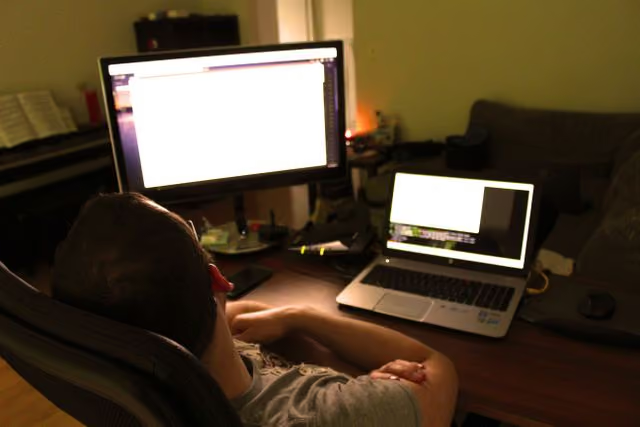
How short micro-sessions of activity can help your health and well-being
How sedentary or active do you think you are? Most of us don’t believe that we’re leading a sedentary lifestyle, yet according to the CDC, 25% of US adults are physically inactive, and 60% are insufficiently active. Americans average 7.7 hours per day of sedentary activity, and 55% of their waking time engaged in sedentary behaviors.
If you’ve been wondering how to incorporate more movement into your daily routine, don’t worry, you’re not alone! Breaking out of a sedentary daily routine can be challenging, but the benefits of physical activity are well worth the effort, and even brief physical activity yields big benefits.
While “exercise” itself isn’t required on a Revero program, incorporating some basic movement is still a proven way to help your health if you choose to. Let’s explore some simple strategies to add physical activity to your life in a stress-free way!
Hidden Risks of Sedentary Time
Let’s first briefly review the myriad harmful effects of inactivity. When we are still for too long at a time, the body is affected in many different ways.
- Reduced lipoprotein lipase activity, so we burn less fat
- Reduced muscle metabolism reduces our ability to move without fatigue.
- Lipid metabolism is impaired, allowing triglycerides to accumulate in the blood.
- Carbohydrate metabolism is decreased, raising blood glucose and insulin.
- Insulin sensitivity is reduced.
- Cardiac function is decreased.
- Chronically elevated inflammation
- Bone density is reduced because the bone is constantly remodeling in response to stress.
This cascade of harmful events promotes increases in all-cause mortality, cardiovascular disease risk, cancer risk, and risk factors such as diabetes, high blood pressure, and altered blood lipids. These problems tend to “sneak up” on us because we don’t often pay much attention to how much of our time is sedentary.
A Brief Solution to the Dilemma
In the last few years, research has validated the idea that breaking up sedentary periods with brief bouts of physical activity has tremendous health benefits. These benefits include:
- Improvements in metabolic health
- Reduced inflammation
- Reduced all-cause mortality
- Reduced fatigue
- Less low back pain
- Better work productivity
- Improved cognition
What Sort of Activity Is Needed?
Adding physical activity involves getting up from the chair or couch about every 30 minutes and moving in some way. Even getting into a healthier static position can yield the benefits above.
Squatting
This is one of the basic functional human movements, and your body evolved to use squatting as a useful position. For our purposes, let’s look at both a primal squat and the movement we know as squatting.
Our bodies evolved to use the squat as the position for having a bowel movement. In Western society, most people use a flushing toilet that involves a sitting position, which is completely abnormal for this activity and can contribute to constipation, hemorrhoids, and other problems. Continuous sitting has the same risks.
A primal squat is also helpful in relaxing or working with something at ground level. Indigenous people can still be seen to this day squatting to tend campfires, cook food, make tools, or simply relax and talk with one another.
Get into this position by keeping your feet flat on the floor and lowering yourself all the way down without your kneecaps going forward of your toes. If you lack the strength or flexibility to do this comfortably, it may take some work to rebuild this basic ability. Try holding a countertop or door jamb to balance and provide some assistance at first.
Don’t be upset if it’s challenging, but instead, just work at it for 3-5 minutes every 30 minutes. Once you can squat and be comfortable at the bottom, incorporate it into other activities. If you take a break from that article you’re writing to check messages on your phone, squat down to do it.
A squatting movement can also be a useful example of a movement that you can do every 30 minutes. Stand straight with your feet shoulder-width apart, toes slightly pointed out. Now keep your kneecaps behind your toes and your weight on your heels, and go down until your thighs are horizontal and then back up. Repeat as much as possible for your fitness level within that few-minute interval. If you’re more fit, you can use a kettlebell, two gallons of water, or a pair of dumbbells to add resistance as needed.
Push-ups
Incorporating push-ups is also another possibility for these brief breaks. Get out of the chair and do push-ups for a few minutes, scaled to your ability. This might mean a full hands and feet push-up, leaning forward onto a windowsill or kitchen counter and pushing back upright, or any other scaling in between.
Work at it for a few minutes, then go back to what you were doing. Remember to keep your shoulder blade muscles “engaged” so that your shoulder blades don’t flare out and weaken your shoulders.
Pull-ups
If you have access to a pull-up bar and can perform this movement or a scaled version of it, pull-ups are an excellent brief movement option. There are many other benefits to this exercise as well, including shoulder stability and more practical strength.
Planks
Performing a plank is also appropriate for a movement break, even though it is a static position. That’s because your core is getting a serious workout during a plank!
Place your hands and feet (or knees) on the floor like a push-up, then lower onto your forearms and try to stay there until you weaken or your break time is up. Scale according to your abilities as needed.
Walking
Just going for a 3-5 minute walk can really help you get the blood flowing and reduce the bad effects of sedentary activities. If you have a dog, you already have a very willing companion for this.
Our bodies evolved to walk far more than we realize, with some present-world examples being women in Africa who sometimes walk 20 miles to go to a village or retrieve water, and in arid regions of the world, people may walk 20 miles or more to gather branches for a fire.
While walking 20 miles may seem huge by our standards, it is just another day for large numbers of people and has always been a primary human activity.
Make It Easy
Multiple small activity sessions will add up over time and can improve your functional fitness, reduce the harmful effects of sedentary activity, and help you feel better at the end of the day. Consider adding this simple and inexpensive strategy to your daily routine so that you can meet your health goals more quickly.
Start making real progress

Related

Oxalate Problems, and What Foods Have High or Low Oxalates?
A Comparison of Cow and Human Digestive Tract Anatomy