







Understanding Cholesterol, LDL, HDL, and Triglycerides on a Low-Carb Diet

Separating fear from fact to move forward with confidence
Do you get a helpless, anxious, or nervous feeling when you’re receiving labwork results? Well, now you can relax. In this article, you’ll receive critical information to help you understand these tests and make informed and confident choices about your health.
Lab tests evaluating the levels of fats in your blood are known as blood lipid tests. There is no single value that is completely predictive of heart disease. Still, ratios between these values can predict heart disease risk, and individual values may also suggest potential problems depending on other values. Understanding these blood lipids is important for implementing health strategies with confidence.
Cholesterol
Cholesterol is perhaps the most misunderstood, maligned molecule in history. Here’s a surprise: did you know cholesterol is essential to life, so much so that your body and brain manufacture it? Your brain is composed of 20% cholesterol, and your hormones and cell membranes are built from cholesterol. Cholesterol is critical to life itself. But, too much of some forms in certain situations can promote heart disease.
Does Cholesterol, or LDL Cholesterol, Cause Heart Disease?
It is common that people who go on a low-carbohydrate diet find that their total cholesterol or LDL cholesterol have gone up. Is that a bad thing? You’re losing weight and feeling great!
You may, unless you’ve been living an extremely secluded life, have been told and believe that cholesterol causes heart disease. You may believe that LDL cholesterol is “the bad cholesterol.” People may be questioning your diet, saying that the meat and saturated fat could cause you to develop clogged arteries and heart disease.
These beliefs are all built on the idea that dietary saturated fat causes heart disease. That was a falsehood promoted by Ancel Keys, and it has been repeated ad nauseum since his time. To get the full picture, check out the article “The Trial and Vindication of Saturated Fat” in your app.
In short, no, it isn’t nearly that simple, and there is now considerable evidence that heart disease is promoted by inflammation and insulin resistance or diabetes.
Having diabetes raises your risk of developing atherosclerosis (plaque in your arteries) by a wide margin. This risk is increased for every year spent with diabetes. Other factors that cause heart disease are:
Triglyceride : HDL Ratio
If you divide your triglyceride level by your HDL level, the result is your TG: HDL ratio. This number is important as it is predictive of your risk of developing plaque in your arteries and cardiovascular disease.
- 1.0 is considered a very low risk, typically seen in well-trained and appropriately nourished athletes
- 2.0 is considered low risk
- Over 3.0 indicates a significantly increased risk of heart attack and stroke
People on low-carbohydrate diets often find that their LDL, HDL, and total cholesterol values rise, but triglycerides go down. The result is higher numbers but a much lower risk.
What Makes Cholesterol and LDL Rise?
You might be surprised to learn that LDL cholesterol isn’t just less harmful than previously thought, but has health benefits. LDL cholesterol participates in delivering cholesterol and fat the body’s cells to use for fuel. That happens on a much greater scale when a person is in fat-burning mode or ketosis, so it shouldn’t be surprising that LDL levels rise.
When you eat a low-carbohydrate diet with little to no sugar, an elevated LDL cholesterol level does not increase your heart disease risk because studies have shown that it’s mostly large-particle LDL. The more hazardous LDL is small-particle, which is promoted by dietary carbohydrates and inflammation. An elevated overall LDL level is associated with a lower overall risk of dying, and a low LDL level is associated with a higher mortality risk.
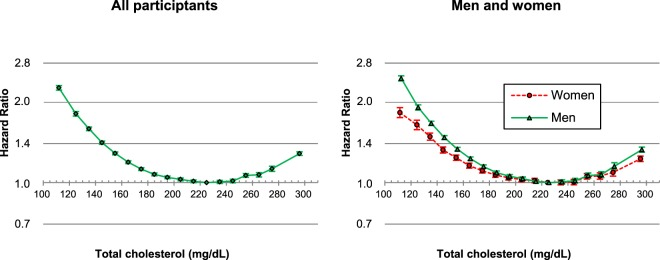
(Yi SW, Yi JJ, Ohrr H. Total cholesterol and all-cause mortality by sex and age: a prospective cohort study among 12.8 million adults. Sci Rep. 2019 Feb 7;9(1):1596)
One way to know if your LDL particles are probably large is to consider your other numbers. If your triglycerides are down and your HDL is up, these are positive changes that indicate a shift toward better metabolic health. It’s logical to think that your LDL would also be affected in a way that trends toward better outcomes.
Seeing the Big Picture of Blood Lipids
Your blood lipid tests can provide valuable clues about cardiovascular risk, and it’s important to know what to do about them. With the right information, you can make the right changes without fear and anxiety.
Your total cholesterol or LDL may go up due to adding more saturated fats to your diet. Since you’ll be cutting back on carbohydrates and eliminating most sugar, these don’t represent an elevated risk of heart disease.
However, your primary care provider may request that you reduce your saturated fats if your cholesterol is high. This choice is up to you, but if you choose to, we can alter your diet accordingly. We want you to make an informed decision, however.
In addition, there may be some circumstances, such as familial hypercholesterolemia, where we would consider prescribing statin medications if your cholesterol level were to get extremely elevated.
A low-carbohydrate diet will lower your Triglycerides, raise your HDL, lower your Triglyceride: HDL ratio, and lower ApoB levels, reducing your risk of heart disease.
It is important to realize that no single blood lipid value guarantees whether or not you might get heart disease, and these tests should be considered part of the big picture. Now that you know more about blood lipids, you can work with your Revero team to move forward with reducing your risk.
Start making real progress

Related
Understanding Carbohydrate Tolerance and Insulin Resistance

About Intermittent Fasting